Flair PRO 3 vs Flair 58 Plus 2: Which Manual Lever Is the Real Upgrade?
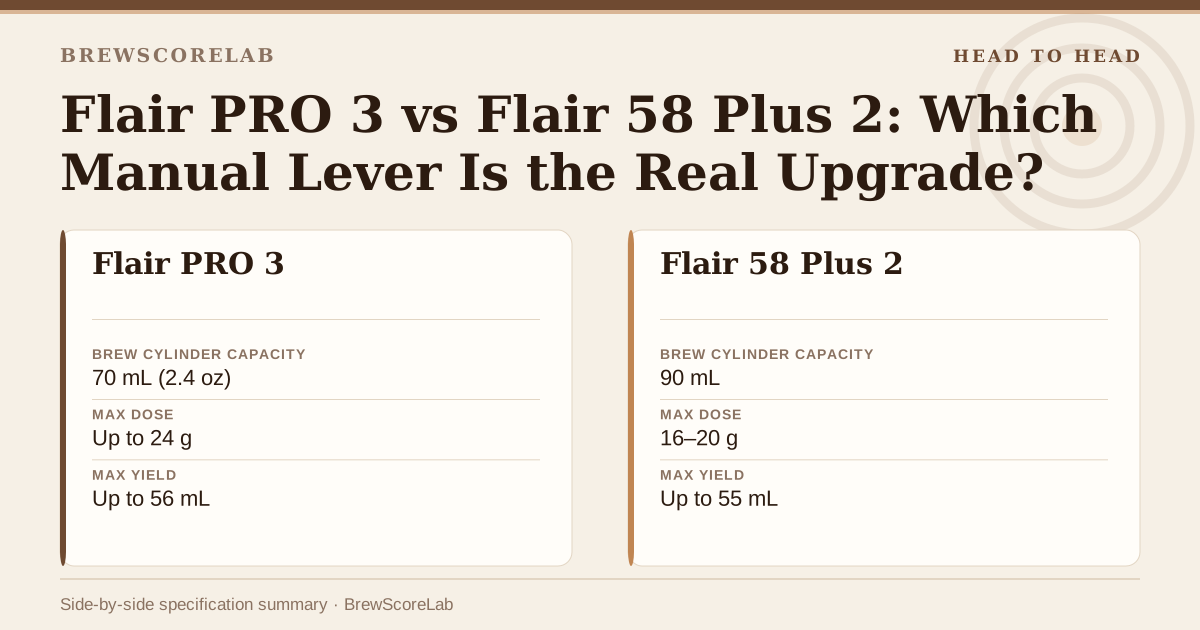
Flair’s lineup has two clearly different philosophies inside it. The PRO 3 is the portable, fully manual lever that asks nothing of a power outlet. The 58 Plus 2 is the flagship: heavier, electrically preheated, and built around the same 58 mm baskets your local cafe uses. Choosing between them is less about which pulls a better shot and more about how much infrastructure you want around it.
Quick Answer
Get the Flair PRO 3 if you want the lightest, most portable serious lever — its no-preheat brew cylinder means you can go from kettle to shot without warming anything up, it packs into an included carrying case, and at about 7 lbs it travels. Get the Flair 58 Plus 2 if this is a countertop machine that stays put: the electric preheat controller with three roast-matched temperature settings removes the biggest variable in manual espresso, and 58 mm baskets mean every tamper, puck screen, and distribution tool on the market fits. One practical note before you shop: Flair’s PRO product page now resolves to the newer 49 PRO, launched in March 2026, so PRO 3 availability at retail is worth checking before you commit.
Specs at a Glance
| Spec | Flair PRO 3 | Flair 58 Plus 2 |
|---|---|---|
| Portafilter / basket | 46 mm, stainless bottomless | 58 mm, three walnut-handled baskets (high dose, low dose, pressurized) |
| Brew cylinder capacity | 70 mL (2.4 oz) | 90 mL |
| Max dose | Up to 24 g | 16–20 g |
| Max yield | Up to 56 mL | Up to 55 mL |
| Preheat method | No-preheat brew cylinder, optional preheat funnel | Electric preheat controller, three levels (dark / medium / light) |
| Power required | None | Plug-in base; unplugs to brew cordless |
| Pressure gauge | Integrated, 6–9 bar espresso zone marked | Integrated |
| Shot mirror | Articulating, integrated | Magnetic articulating mirror included |
| Brew path | Stainless steel | All stainless, no plastic contact |
| Weight | About 7 lbs | About 12 lbs |
| Included | Carrying case, metal tamper, dosing cup and collar, dispersion screen | Walnut palm tamper, puck screen, drip tray, power supply |
The Preheat Question Decides Most of This
Temperature is the hardest variable in manual lever espresso, and these two solve it in opposite directions.
The PRO 3 removes the problem by removing thermal mass. Its brew cylinder uses thinner metal specifically so it does not need preheating — you pour boiled water in and pull. That is a meaningful change from earlier Flair generations where a preheat routine with hot water was effectively mandatory. If you want extra heat for a light roast, the included preheat funnel gives you a way to add it back.
The 58 Plus 2 goes the other way and heats the group electrically. Flair’s spec sheet describes an integrated preheat controller with three settings that roughly correlate to the brewing temperatures needed for dark, medium, and light roasts. You set it, wait, and every shot starts from the same place. That is the closest a manual lever gets to the temperature stability of a PID’d machine, and it is why the 58 Plus 2 is the one people keep on the counter rather than in a cupboard. It also unplugs entirely if you want to brew away from an outlet — the preheat is a convenience, not a dependency.
If you are coming from an earlier Flair, our PRO 2 versus Flair 58 comparison covers the previous generation of this same argument, and the Flair 58 Plus 2 review goes deeper on the heated frame.
The Basket Size Is Not a Detail
46 mm versus 58 mm changes more than accessory shopping.
A 46 mm basket produces a taller, narrower puck. More contact time per gram, more flow resistance, and a shot with noticeably more body — this is why smaller-format levers have a reputation for thick, syrupy espresso. It also means the PRO 3 handles smaller doses gracefully, which is useful if you drink single shots or are working through an expensive bag of coffee.
The 58 mm format on the 58 Plus 2 is the industry standard, and the practical benefit is the ecosystem. Every basket, puck screen, WDT tool, and distribution tool is made for 58 mm first. Anything in our puck screen guide or WDT tool roundup will fit the 58 Plus 2; for the PRO 3 you are shopping a narrower selection. It also means your dialling-in knowledge transfers directly if you later move to a pump machine.
Worth noting on dose: the PRO 3’s 70 mL cylinder supports doses up to 24 g, higher than the 58 Plus 2’s stated 16–20 g range despite the smaller basket diameter. Yield is effectively identical between the two at around 55–56 mL, so both are built for a normal double, not a lungo.
Portability and Where It Lives
The PRO 3 weighs about 7 lbs and ships with a carrying case. That combination is the whole argument — it goes to an office, a rental, a campsite with a kettle. The 58 Plus 2 is about 12 lbs before you account for the power supply, and while it is technically portable, nobody is packing it for a weekend.
There is a second dimension here: cleanup. Both machines break down for washing, both use stainless brew paths, and neither has a pump or boiler to descale. That is the underrated advantage of manual levers generally, and part of why they keep appearing in our best lever espresso machine roundup alongside far more expensive equipment.
What Neither Machine Does
Neither has a steam wand. If you want cappuccinos, you need a separate milk solution — a standalone frother, a steam wand device, or a stovetop approach with a good frothing pitcher. Budget for that before you decide either of these is a complete setup.
Neither includes a grinder, and manual levers are unusually sensitive to grind quality because you are supplying the pressure yourself — a choked puck is felt in your arm, not absorbed by a pump. A capable hand grinder from our hand grinder guide is not optional equipment here.
FAQ
Is the Flair 58 Plus 2 worth it over the PRO 3?
Worth it if the machine lives on your counter and you value temperature repeatability and 58 mm accessory compatibility. Not worth it if you want portability, since the 58 Plus 2’s weight and power supply undercut the main reason to own a lever in the first place. The shots themselves are both excellent; the workflow is what differs.
Do I need to preheat the Flair PRO 3?
No. The PRO 3’s brew cylinder is designed with reduced thermal mass specifically so preheating is not required — that is one of its headline changes. A preheat funnel is included if you want to add heat for light roasts, but the default workflow is pour and pull.
Can the Flair 58 Plus 2 make espresso without being plugged in?
Yes. The preheat controller is a convenience feature; the machine unplugs and brews as a fully manual lever. You lose the temperature control and go back to managing heat with your kettle, which is exactly how the PRO 3 works.
Which one is better for a beginner?
The 58 Plus 2, mildly. Controlled preheat removes one large variable, the pressure gauge tells you what your grind is doing, and the standard basket size means every tutorial online applies directly. The PRO 3 is not hard to learn, but you own the temperature problem yourself.
What is the difference between the PRO 3 and the new Flair 49 PRO?
The Flair 49 PRO is the current mid-range PRO-line machine and uses a 49 mm portafilter rather than the PRO 3’s 46 mm. Flair’s own listing specs it at a 12–20 g dose, 90 ml water capacity, a 6–9 bar range on the integrated gauge, and a 5-year limited warranty. Flair’s stated case for the larger format is that a deeper basket tolerates grind inconsistency better and handles low doses around 12–14 g more gracefully. Since Flair’s PRO product page now points at the 49 PRO, check current stock before ordering a PRO 3 — a discontinued model can be a bargain or a parts headache depending on the seller.
Do these make real espresso or something closer to moka pot coffee?
Real espresso. Both are marked for the 6–9 bar range on their integrated gauges, which is genuine espresso pressure, and both use non-pressurized baskets by default. If that distinction is new to you, our explainer on pressurized versus non-pressurized portafilters is worth five minutes.
Conclusion
The PRO 3 and the 58 Plus 2 are the same idea executed for two different lives. The PRO 3 is light, needs no power, ships in a case, and its no-preheat cylinder eliminates the most annoying ritual in manual espresso. The 58 Plus 2 is the counter machine — heavier, electrically preheated for repeatable temperature, and plugged into the 58 mm accessory ecosystem you will use for the rest of your coffee life.
If you move around or you value the ritual over the infrastructure, take the PRO 3 while it is still on shelves. If this is your one machine and it is not going anywhere, the 58 Plus 2 is the better long-term tool — and it sits comfortably among the best manual espresso makers available today.