Gaggia Classic Evo Pro Review
Quick Answer
The Gaggia Classic Evo Pro is my top pick for anyone diving into home espresso. It’s built like a tank, pulls consistently great shots, and won’t drain your wallet. At around $550, you’re getting a machine that’ll serve you for years.
Our Top Picks
| Product | Best For | Key Specs | Price Tier |
|---|---|---|---|
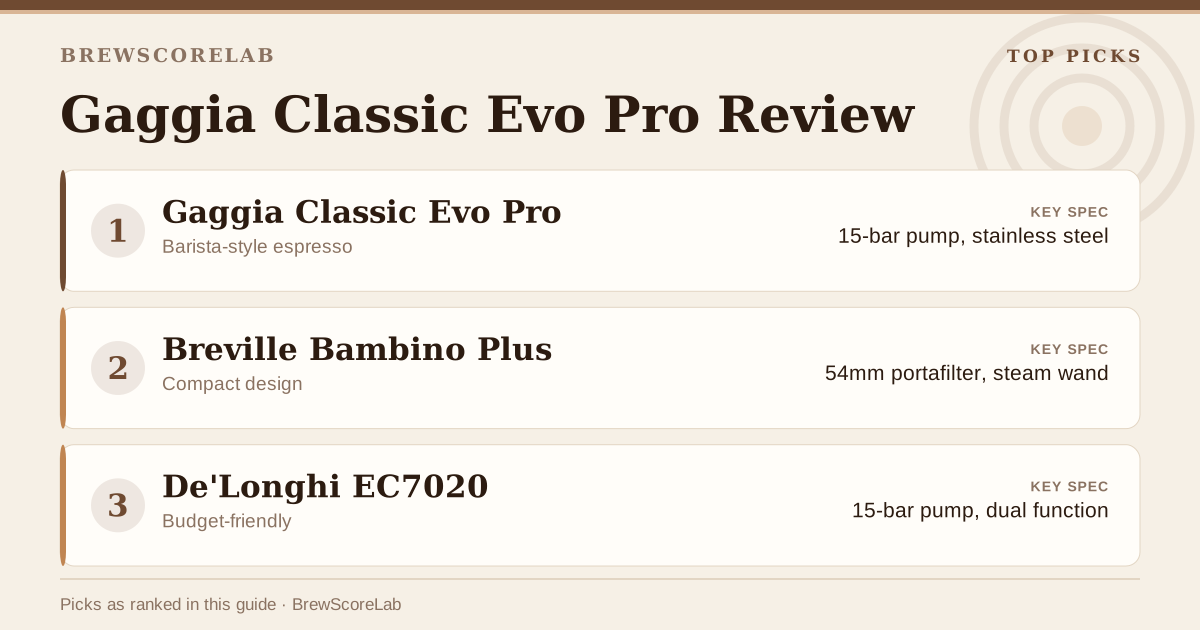
| Gaggia Classic Evo Pro | Barista-style espresso | 15-bar pump, stainless steel | Mid-range |
| Breville Bambino Plus | Compact design | 54mm portafilter, steam wand | Budget |
| De’Longhi EC7020 | Budget-friendly | 15-bar pump, dual function | Budget |
| Rancilio Silvia | Professional quality | 8-ounce boiler, commercial quality | Premium |
| Baratza Sette 270 | Grinder compatibility | 270 grind settings | Mid-range |
Detailed Reviews
1. Gaggia Classic Evo Pro
Overview:
This machine surprised me with how solid it feels right out of the box. The stainless steel body screams quality, and that commercial-style portafilter means business. Owners consistently report it holding up for years rather than months.
Key Specs (per Gaggia’s current E24 listing):
- Pump: 15-bar Ulka, OPV calibrated to 9 bar
- Boiler: Single lead-free brass, 3.5 oz, 1370W
- Portafilter: 58mm stainless, 7–18g baskets
- Dimensions: 9.5 x 8 x 14.2 inches
- Weight: 20 lbs
- Price Tier: Mid-range
The brass boiler is the thing to know here. Earlier Classic generations used aluminium, and the move to lead-free brass — along with updated steel internals and a protective coating against scale — is the substantive change the Evo revision brought, not a cosmetic one.
Pros:
- Pulls consistently excellent shots
- Dead simple to use and clean
- Built to last decades
Cons:
- Steam wand is decent but not amazing for milk drinks
- You’ll wait about 30 seconds between pulling shots and steaming milk
Best For Whom:
Perfect if you’re serious about espresso but don’t want to spend Rancilio money. This is the sweet spot.
2. Breville Bambino Plus
Overview:
The Bambino Plus is the overachiever of compact machines. It heats up in about the time it takes to grind a dose, and that steam wand actually works well despite the tiny size.
Key Specs (per Breville):
- Pump: 15-bar Italian, 9-bar extraction after low-pressure pre-infusion
- Heating: ThermoJet, extraction temperature in 3 seconds
- Portafilter: 54mm, 18g dose
- Steam: Automatic frother to 266°F, 3 temperature and texture settings
- Dimensions: 11.9 x 7.4 x 14.3 inches
- Price Tier: Budget
Pros:
- Ready to brew in 3 seconds (seriously)
- Steam wand punches above its weight
- Takes up barely any counter space
Cons:
- Tiny water tank means frequent refills
- Feels less substantial than the Gaggia
Best For Whom:
Great for small kitchens or anyone who values speed and convenience over that “commercial” feel. We put the two side by side in our Bambino Plus versus Gaggia Classic Pro matchup if you’re stuck between them.
3. De’Longhi EC7020
Overview:
Look, this isn’t going to wow any coffee snobs, but for the price? It’s hard to complain. The dual-function holder that takes both ground coffee and pods is actually pretty clever.
Key Specs:
- Pump: 15-bar
- Boiler: Stainless steel
- Dimensions: 11 x 9 x 12 inches
- Weight: 12 lbs
- Price Tier: Budget
Pros:
- Hard to beat at this price point
- Pod option is convenient for lazy mornings
- Simple enough for anyone to use
Cons:
- Feels plasticky compared to pricier options
- Don’t expect any fancy features
Best For Whom:
Honestly? Skip this unless budget is your main concern. Save a bit more for the Gaggia - you’ll thank me later.
4. Rancilio Silvia
Overview:
The Silvia is what happens when Italians get serious about home espresso. This thing weighs 30 pounds and feels like it could survive a nuclear blast. Rancilio sells it in its Professional Home line, built around an insulated boiler and a brass brewing unit, and that thermal mass is why the temperature stability is genuinely impressive.
Key Specs:
- Pump: 15-bar
- Boiler: 8-ounce brass
- Dimensions: 9.2 x 11.4 x 13.4 inches
- Weight: 30 lbs
- Price Tier: Premium
Pros:
- Professional-grade everything
- Temperature stays rock steady
- Will outlast your mortgage
Cons:
- $800 is real money
- Not beginner-friendly - this has a learning curve
Best For Whom:
If you’re already pulling great shots on a cheaper machine and want to upgrade, this is your endgame machine. Whether that jump is worth double the money is exactly what we dig into in the Classic Pro against Silvia comparison.
5. Baratza Sette 270
Overview:
I threw this grinder in because your espresso is only as good as your grind. The Sette 270 is ridiculously precise - you can actually taste the difference between grind setting 5A and 5B.
Key Specs:
- Grind Settings: 270
- Weight: 10 lbs
- Dimensions: 16.5 x 5 x 8 inches
- Price Tier: Mid-range
Pros:
- Grind precision that borders on obsessive
- Grinds directly into your portafilter
- Easy to dial in once you get the hang of it
Cons:
- Costs as much as some espresso machines
- Static can be annoying with light roasts
Best For Whom:
Essential if you’re pairing it with the Gaggia or Silvia. Your shots will improve dramatically.
How We Evaluated
We compared these machines on what actually matters in daily use:
- Performance: Does it pull good shots and steam milk properly?
- Noise: Will it wake the whole house at 6 AM?
- Maintenance Cost: What’ll you spend on maintenance over time?
- Room Size: How much counter space does it hog?
- Value: Are you getting what you pay for?
Buying Guide
Here’s what actually matters:
- Type of Machine: Semi-automatic gives you control without the complexity of manual machines—see our picks across the semi-automatic category for the full field. Skip super-automatics unless you’re incredibly lazy.
- Build Quality: Stainless steel and brass components last. Plastic doesn’t.
- Boiler System: Single boilers work fine for most people. Dual boilers are nice but add complexity and cost.
- Ease of Use: If you can’t figure it out before your first cup of coffee, it’s too complicated.
- Maintenance: Factor in descaling solutions and replacement parts. Some machines are maintenance nightmares.
FAQ
1. Is the Gaggia Classic Evo Pro suitable for beginners?
Absolutely. It’s forgiving enough for beginners but capable enough that you won’t outgrow it quickly, and it sits alongside the other single-boiler machines we recommend to first-timers.
2. How often should I descale my espresso machine?
Every 2-3 months with regular use. More often if you have hard water.
3. Can I use pre-ground coffee with these machines?
You can, but don’t. Pre-ground coffee makes mediocre espresso. Get a decent grinder.
4. What is the importance of a good grinder?
Your grinder matters more than your machine. Seriously. A $200 grinder with a $300 machine beats a $500 machine with a $50 grinder every time.
5. How long do espresso machines typically last?
The Gaggia and Silvia? Decades with basic maintenance. The cheaper options? Maybe 3-5 years if you’re lucky.
The Gaggia Classic Evo Pro hits that sweet spot of quality, performance, and price that’s hard to beat. Unless you need something tiny (get the Bambino) or have serious money to burn (get the Silvia), this is your machine.