Niche Duo vs Niche Zero: Is the 83mm Flat Burr Worth the Jump?
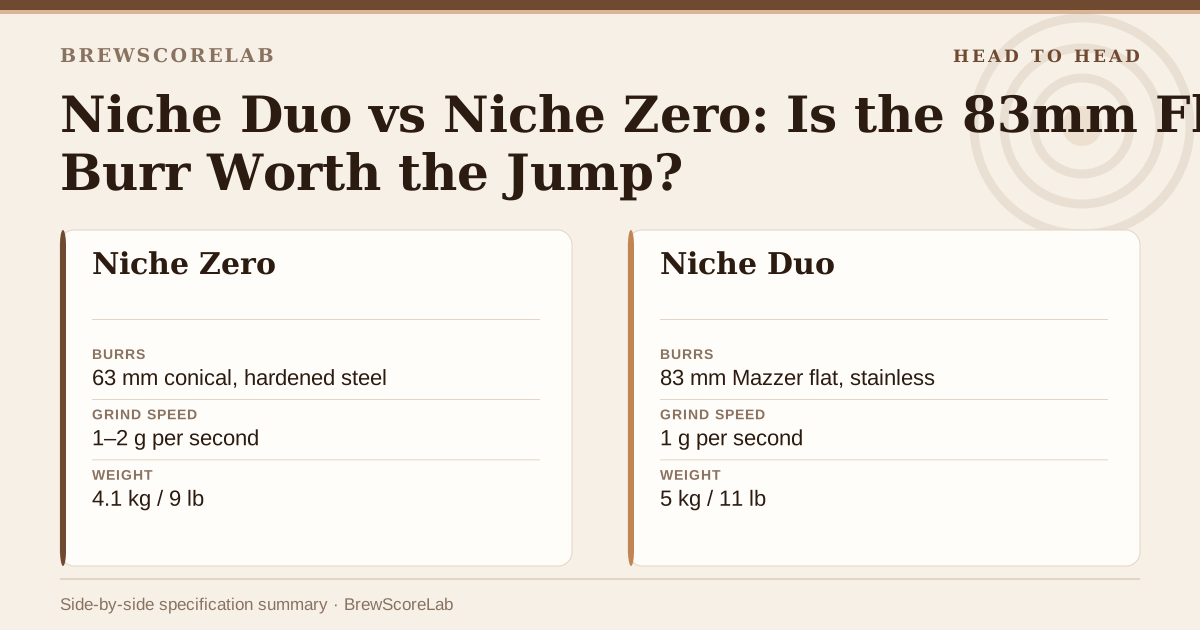
The Niche Zero built its reputation on one idea: single dose in, single dose out, with almost nothing left behind. The Duo keeps that workflow and swaps the 63 mm conical burrs for 83 mm Mazzer flats — plus the option of a second burr set for filter. That is a bigger change than it sounds, and it does not automatically make the Duo the better grinder for you.
Quick Answer
Get the Niche Zero if espresso is the job and counter space matters — the 63 mm conical burrs give you the sweet, heavy, forgiving cup that made the grinder famous, it grinds faster (1–2 g per second versus the Duo’s 1 g per second), and it is smaller and lighter on every dimension. Get the Niche Duo if you brew both espresso and filter seriously and want burrs matched to each, or if you specifically want the clarity and separation that large flat burrs give light roasts. The Duo is not an upgrade to the Zero so much as a different flavour philosophy in the same chassis.
Specs at a Glance
| Spec | Niche Zero | Niche Duo |
|---|---|---|
| Burrs | 63 mm conical, hardened steel | 83 mm Mazzer flat, stainless |
| Burr sets | One set, all brew methods | Two swappable sets — espresso and filter — chosen at purchase |
| Grind adjustment | Infinite stepless dial | Infinite stepless dial |
| Grind speed | 1–2 g per second | 1 g per second |
| Dose consistency | Less than ±0.2 g | Less than ±0.2 g |
| Retention | Near-zero, single dose workflow | Near-zero, patented straight-through design |
| Dimensions (W×L×H) | 122 × 211 × 311 mm | 135 × 230 × 355 mm (480 mm with lid upright) |
| Weight | 4.1 kg / 9 lb | 5 kg / 11 lb |
| Published noise | 72 dB while grinding | 72 dB while grinding |
| Body | Aluminium with real oak trim | Aluminium |
Those figures come from Niche’s own listings for the Zero and the Duo, which is worth checking yourself before you commit — both are frequently out of stock and the spec tables are the only place the dimensions are published in full.
Two rows are worth flagging. First, the Duo is taller than it looks on paper — 355 mm standing, and 480 mm with the lid up, which will not clear a low wall cabinet. Measure before you order. Second, the published noise figure is identical, but the sound character is not: larger flat burrs and a heavier body produce a different note, and owners generally describe the Duo as the more present of the two in a quiet kitchen.
Conical vs Flat: What Actually Changes in the Cup
This is the whole comparison, so it is worth being precise rather than mystical about it.
Conical burrs (Zero) produce a wider particle distribution — a mix of finer and coarser particles. In espresso that tends to read as body, sweetness, and a rounder, more blended cup. It is also more forgiving: small grind errors move the shot less dramatically, which is why the Zero has such a reputation as a set-and-forget espresso grinder.
Large flat burrs (Duo) produce a narrower, more uniform distribution. In espresso that reads as clarity, acidity, and separation of individual flavours — you taste the components rather than the blend. The tradeoff is sensitivity: the same uniformity that gives you clarity also means the grinder tells you immediately when your dose or distribution is off.
Neither is objectively better. If you drink medium and dark roasts, make milk drinks, or want espresso that is consistently pleasant without fuss, the Zero’s conical profile is the one you want. If you buy light roast single origins from a roaster whose tasting notes you actually care about, the Duo’s flats are built to show you those notes. We make the same distinction in Niche Zero versus the DF64, which is the classic conical-versus-flat comparison at a lower tier.
The Two-Burr-Set Argument
The Duo’s real headline is not the burr diameter, it is that Niche offers two 83 mm sets — one geometry optimised for espresso, one for filter — and they can be swapped in a few minutes. You do not run both at once; you change sets when your brewing changes.
This is genuinely useful for a specific person: someone who pulls espresso on weekday mornings and brews pourover or batch filter at the weekend, and who is not satisfied with a single compromise burr. Buying both sets means one grinder covers both jobs properly instead of adequately.
It is also entirely wasted on someone who only pulls espresso. If you have never once wished your grinder were better at filter, the second set is money you should put into beans, and the Zero — which handles everything from espresso to French press on its stepless dial — is the more sensible purchase. Our long-term Niche Zero review covers how it behaves across brew methods.
Workflow, Retention and Speed
Both grinders are built around the same single dose ritual: weigh your beans, drop them in, grind, and the dosing cup catches everything. Both publish dose consistency of better than ±0.2 g, which is the number that actually matters for repeatability. That kind of published, comparable figure is exactly what the Specialty Coffee Association is trying to standardise with SCA-320, its specifications and test-method standard for home coffee grinders.
Retention is near-zero on both. The Duo uses a patented straight-through path so grounds do not sit in a chute; the Zero achieves the same result with its compact conical arrangement and no-popcorning hopper disc. In practice, neither will hand you yesterday’s beans in today’s shot, which is the entire point of single dosing and the main reason both appear in our single dose grinder guide.
Where they differ is throughput. The Zero grinds at 1–2 g per second; the Duo is quoted at 1 g per second. For an 18 g dose that is a difference of a few seconds — irrelevant for a home user, mildly annoying if you are grinding 40 g for a filter batch every morning.
Counter Space and Living With Them
The Zero is the smaller machine on all three axes and about 900 g lighter. With its oak trim it also reads as a piece of furniture rather than equipment, which matters more than enthusiasts like to admit in a shared kitchen.
The Duo trades that for presence. It is wider, longer, taller, and heavier, and the extra mass does help it sit still under load. If your grinder lives under a cabinet, check the 480 mm lid-up height before anything else — that single measurement disqualifies the Duo in a lot of kitchens.
FAQ
Is the Niche Duo worth it over the Niche Zero?
It is worth it if you brew filter as seriously as espresso and will buy both burr sets, or if you specifically want light roast clarity that conical burrs will not give you. If you pull espresso for milk drinks and want a grinder you can stop thinking about, the Zero remains the better fit and takes up less room.
Can the Niche Duo grind for espresso and filter at the same time?
No — this is the most common misunderstanding about the name. The Duo ships with your choice of burr sets and you physically swap them, a job of a few minutes. It is one grinder that can be configured two ways, not a grinder with two simultaneous grind paths.
Which is better for light roasts?
The Duo. Large flat burrs produce a more uniform particle distribution, which is the standard tool for pulling clarity and acidity out of dense light roast coffees. The Zero can grind light roasts perfectly well, but the conical profile blends flavours where the Duo separates them.
Is the Niche Duo louder than the Niche Zero?
Both are published at 72 dB while grinding, so on paper they are equal. The Duo’s larger flat burrs and heavier body change the character of the sound rather than the volume, and owners commonly report it as the more noticeable of the two. Neither is anywhere near the shriek of a cheap blade or entry burr grinder.
Do both hold their grind setting when you change brew methods?
Both use an infinite stepless dial with no detents, so you can return to a setting but there are no clicks to count. Owners of both typically mark the collar or keep a note of dial positions. Swapping the Duo’s burr sets also means re-dialling from scratch, which is a real cost of the two-set workflow.
Should I buy either of these as my first espresso grinder?
Both are more grinder than a beginner needs, but neither is wasted — they are the class of tool people arrive at eventually. If you are earlier in the journey, our burr grinder guide for espresso and the Niche versus Eureka Mignon comparison cover the step below.
Conclusion
The Duo is not the Zero with bigger burrs. It is Niche answering a different question — what if one single dose grinder could be properly optimised for espresso and properly optimised for filter, just not at the same moment? If that question describes your coffee week, the Duo is a strong and well-executed answer, provided your cabinet clears its lid.
If espresso is the whole job, the Zero still does what made it famous: fast, near-zero retention, forgiving conical grinding in a footprint that fits anywhere. Most people reading this comparison will be better served by the Zero and a better bag of coffee than by the 83 mm flats — and that is a cheaper conclusion than the alternative.