De'Longhi La Specialista Maestro vs Breville Barista Pro: Recipe Buttons or Manual Control?
These two sit close enough on price lists that people cross-shop them constantly, but they are built for opposite temperaments. Breville and De’Longhi publish full specs for both. The De’Longhi La Specialista Maestro wants to hand you a finished flat white from a menu. The Breville Barista Pro wants to hand you a portafilter and thirty grind settings. Both grind, both steam, both make good coffee — they just disagree about who is driving.
Quick Answer
Get the La Specialista Maestro if you want preset recipes, an automatic milk carafe alongside a manual wand, cold brew built in, and the shortest possible distance between beans and a latte. Get the Breville Barista Pro if you want to dial shots in yourself — 30 grind settings, a 54mm basket, a manual steam wand and near-instant ThermoJet heating give you more room to improve. If your household orders drinks by name, buy the Maestro. If you want to learn espresso, buy the Barista Pro.
At a Glance
| Feature | De’Longhi La Specialista Maestro | Breville Barista Pro |
|---|---|---|
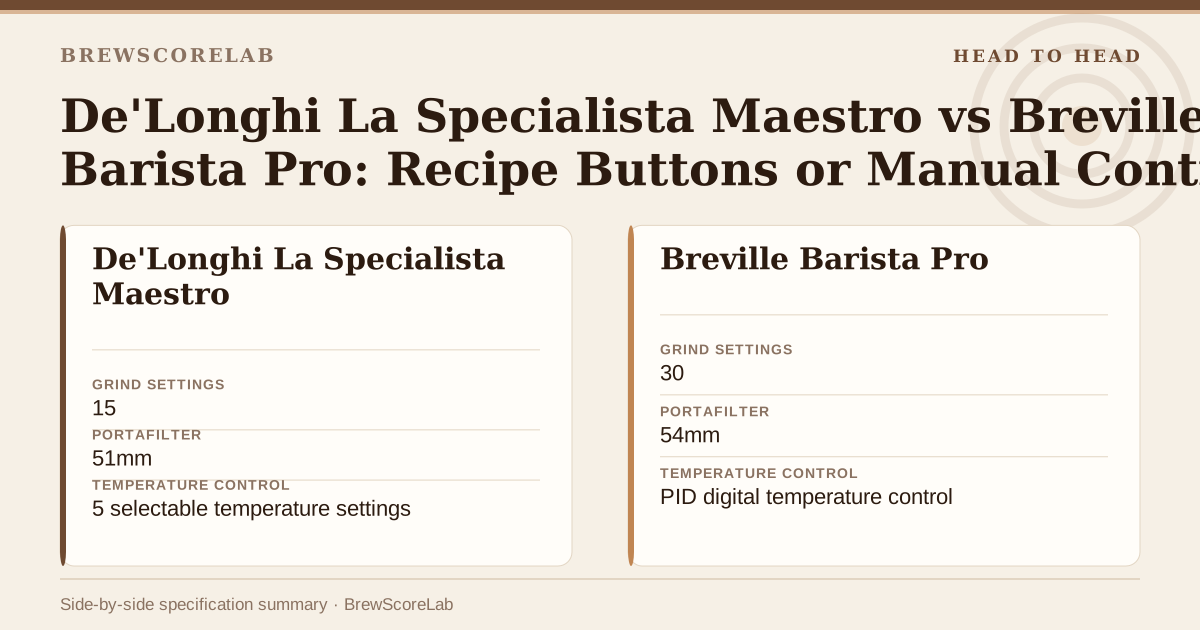
| Grind settings | 15 | 30 |
| Portafilter | 51mm | 54mm |
| Tamping | Smart Tamping Technology (lever-assisted) | Manual, tamper included |
| Heating | Dual heating system — separate brew and steam heating | Single ThermoJet, extraction temperature in about 3 seconds |
| Temperature control | 5 selectable temperature settings | PID digital temperature control |
| Pump | 19-bar Italian pump | 9-bar extraction pressure |
| Milk | LatteCrema automatic frother and a manual steam wand | Manual steam wand only |
| Preset recipes | 8, including cold brew and espresso cool | None — you drive |
| Cold drinks | Yes, cold brew in about five minutes | No |
| Interface | Recipe buttons and dial | LCD with grind timer and shot clock |
| Water tank | 2.5L | About 2L |
| Price tier | Mid-to-premium | Mid |
Automation vs Adjustability
The Maestro’s headline is its eight preset recipes — espresso, americano, coffee, cappuccino, flat white, latte macchiato, espresso cool and cold brew. Pick one, and the machine handles dose, extraction and, if you use the LatteCrema carafe, the milk as well. There is a manual steam wand on the side for when you want to texture milk yourself, which is a genuinely nice piece of design: it means the machine can be a button box on a Tuesday and a manual machine on a Sunday.
The Barista Pro has no recipes. It has a grinder with 30 settings, a grind timer, a shot clock on the LCD, and a steam wand you operate yourself. Everything that happens in the cup is a consequence of a decision you made. That is more work, and it is also the only way to get better, which is why it is a staple of our espresso machines with built-in grinders roundup rather than the super-automatic lists.
Neither approach is wrong. The question is whether you find dialling in a hobby or a chore.
Grind Settings: 30 vs 15
This is the most consequential number on the table and the easiest to overlook.
The Barista Pro’s integrated conical burr grinder offers 30 settings that feed directly into the 54mm portafilter through a hands-free cradle. Thirty steps across the espresso range means when a shot runs three seconds fast, there is a setting that fixes it without overshooting. That resolution is what makes the shot clock useful — you can actually act on the feedback.
The Maestro’s Italian-made burr grinder has 15 settings covering single and double doses. It works, and De’Longhi’s Smart Tamping lever compensates for a lot, but coarser steps mean bigger jumps when you adjust. Paired with preset recipes, that is consistent with the design intent: the machine is not asking you to chase a 1-second difference, it is asking you to press “flat white.”
If you plan to buy single-origin beans and re-dial every bag, the extra resolution matters. If you buy one blend and keep buying it, it matters far less.
Portafilter Size and the Accessory Question
The Maestro uses a 51mm portafilter; the Barista Pro uses 54mm. Neither is the 58mm commercial standard, so both live in a narrower aftermarket than prosumer machines do.
Between the two, Breville’s 54mm ecosystem is the deeper one — bottomless portafilters, precision baskets, distribution tools and puck screens are all easy to find because Breville sells so many machines in that format. De’Longhi’s 51mm accessories exist but the selection is thinner. If you expect to buy upgrade parts, the Barista Pro gives you more to buy.
Milk Drinks
The Maestro can do it either way, and that is a real advantage. The LatteCrema carafe automates textured milk for cappuccinos and lattes; the separate commercial-style steam wand lets you pour art when you feel like it. For a household where one person cares about coffee and three people just want a drink, that dual path removes arguments.
The Barista Pro gives you one manual steam wand and expects you to learn it. The good news is that it is a capable wand and Breville machines are the most common starting point for people learning to pour — the technique in our latte art at home guide is written on machines exactly like this. The bad news is that there is no fallback on a morning when you have no patience.
One structural note: the Maestro uses separate heating for brewing and steaming, so it does not have to reheat between the shot and the milk in the way single-thermocoil machines do. The Barista Pro’s ThermoJet is fast enough that the switchover is quick, but it is a switchover. Neither machine brews and steams truly simultaneously the way a dual boiler does — if that is your requirement, look at our best espresso machines for lattes picks instead.
Cold Brew and Warm-Up
Two small things that decide more purchases than they should.
The Maestro makes cold brew in about five minutes and includes an espresso cool setting for lower-temperature extraction. If iced coffee is a summer habit in your house, that is a feature the Barista Pro simply does not have.
The Barista Pro reaches extraction temperature in about three seconds thanks to ThermoJet. There is no warm-up ritual at all — switch on, pull a shot. For anyone who has skipped home espresso because the machine wasn’t ready, that removes the excuse entirely.
Who Should Buy Which?
Choose the La Specialista Maestro if you:
- Want recipe buttons for cappuccino, flat white and latte
- Want an automatic milk carafe with a manual wand available as a second option
- Drink cold brew or iced espresso regularly
- Prefer a bigger 2.5L tank and fewer decisions per cup
Choose the Breville Barista Pro if you:
- Want to dial shots in and see the effect of each change
- Value 30 grind settings and a shot clock over presets
- Want instant heat-up with no warm-up wait
- Plan to buy accessories and want the deeper 54mm aftermarket
Working through the wider brand question? Our Breville vs De’Longhi comparison covers the philosophies across both ranges, and La Specialista vs Barista Express is the equivalent matchup one rung down. If you are trying to place the Barista Pro within Breville’s own lineup, start with Barista Express vs Barista Pro.
FAQ
1. Is the De’Longhi La Specialista Maestro better than the Breville Barista Pro? Better at different jobs. The Maestro is better if you want preset drinks, an automatic milk carafe and built-in cold brew. The Barista Pro is better if you want to control extraction yourself — it has twice the grind settings and a shot clock to act on.
2. Which one is easier for a complete beginner? The Maestro, because you can press a recipe button and get a drinkable coffee on day one. The Barista Pro is not hard, but it expects you to learn dose, grind and timing before the results are consistently good.
3. Does the La Specialista Maestro have a real steam wand? Yes. It ships with both the LatteCrema automatic milk system and a separate manual steam wand, so you can automate milk or texture it yourself depending on the morning.
4. Are 15 grind settings enough for espresso? Enough for a blend you buy repeatedly, yes — the Maestro is designed around consistency rather than experimentation. If you rotate single origins and re-dial each bag, the Barista Pro’s 30 settings give you finer adjustment between shots.
5. Can the Breville Barista Pro make cold brew? No. It has no cold extraction mode. The Maestro does, producing cold brew in roughly five minutes plus an espresso cool option.
6. Do either of these use a 58mm portafilter? Neither does. The Maestro uses 51mm and the Barista Pro uses 54mm. If a commercial 58mm group is on your list, you are shopping a tier above both of these — start with the espresso machine buying guide.
Conclusion
The La Specialista Maestro and the Barista Pro both promise café drinks from a single appliance, but they hand you different amounts of the steering wheel. The Maestro answers “how do I get a flat white with the least friction?” — recipes, a milk carafe, cold brew, a manual wand for when you want it. The Barista Pro answers “how do I learn to pull a proper shot?” — 30 grind settings, a shot clock, a manual wand and instant heat. Buy the Maestro for a household that orders by name. Buy the Barista Pro if you want the coffee to get better every month. If you like the De’Longhi philosophy but want a smaller entry point, our La Specialista Arte review is the natural next read.