Profitec RIDE vs Lelit Bianca V3: Which E61 Dual Boiler Deserves Your Counter?
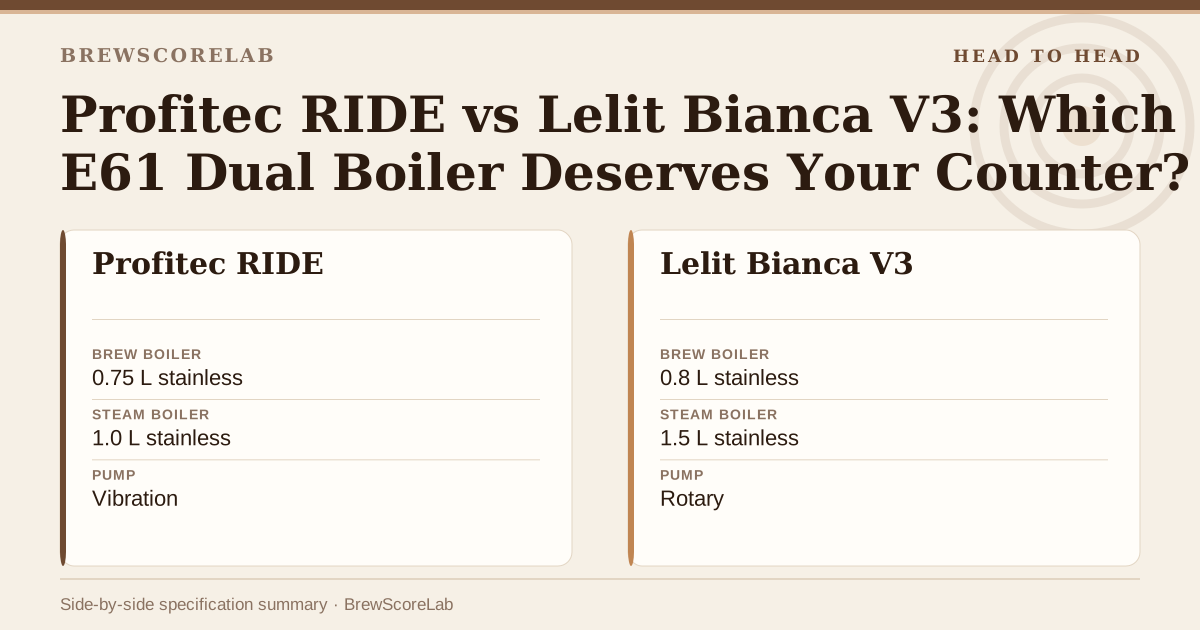
Profitec replaced the Pro 600 with the RIDE, and suddenly the classic E61 dual boiler shootout has a new name in it. The Lelit Bianca V3 has held the “enthusiast E61 with flow control” slot for years, so the comparison people actually want is RIDE versus Bianca — not the older Pro 600 or Pro 700 matchups. Here is how the two stack up on published specs and what that difference means at the machine.
Quick Answer
Get the Profitec RIDE if you want a genuinely low-fuss E61 dual boiler: it heats fast (Profitec’s simultaneous boiler heating means shot-and-cappuccino ready in roughly 10–12 minutes from cold), the OLED PID handles preinfusion programming for you, and flow control is an optional add-on you can skip or bolt on later. Get the Lelit Bianca V3 if pressure and flow profiling is the point of buying at this level — its paddle is standard equipment, its steam boiler is half a litre larger, it uses a rotary pump, and it can be plumbed in or run from a tank you can mount on three different sides. In short: RIDE for the person who wants espresso, Bianca for the person who wants to shape espresso.
Specs at a Glance
| Spec | Profitec RIDE | Lelit Bianca V3 |
|---|---|---|
| Brew boiler | 0.75 L stainless | 0.8 L stainless |
| Steam boiler | 1.0 L stainless | 1.5 L stainless |
| Pump | Vibration | Rotary |
| Water supply | 2.8 L tank | 2.5 L modular tank, mountable on three sides, or plumb-in |
| Flow control | Optional E61 flow control device (fit at purchase or retrofit) | Manual paddle, standard |
| Preinfusion | Programmable active and passive modes via PID | Paddle-controlled, plus V3’s programmable low-flow / auto pre-infusion |
| Display | Low-profile OLED with PID and shot timer | PID plus dual analogue manometers |
| Group | E61-style 58 mm Profitec brew group | E61 58 mm |
| Heat-up behaviour | Simultaneous boiler heating, programmable fast heat-up | Roughly 20 minutes, four selectable power modes |
| Dimensions (W×D×H) | 11.8 × 17.7 × 14.6 in | 11.5 × 16 × 15.75 in |
| Weight | About 62 lbs | About 58 lbs |
Those figures come from the manufacturers directly — Profitec’s RIDE page lists the 0.75 L stainless coffee boiler, 1.0 L steam boiler, independent PID on each, and the modular bottomless portafilter with silicone spout attachments, while Lelit describes the Bianca as an L58E group machine with manual control of the water flow.
The table hides one thing worth saying out loud: these machines are closer on brew-side hardware than the marketing suggests. Both use a 58 mm E61-pattern group, both run PID on both boilers, both hit the same espresso temperatures. The real separation is in how you supply water to the puck and how much milk you plan to steam.
If You Mostly Drink Milk Drinks
Steam capacity is the least glamorous spec on the sheet and the one people regret ignoring. The Bianca V3’s 1.5 L steam boiler is 50% larger than the RIDE’s 1.0 L, and that shows up when you are steaming back-to-back pitchers for a house full of people rather than one flat white a morning.
For a one- or two-drink household, the RIDE’s steam boiler is not a limitation at all — Profitec quotes strong steam performance, and the fast heat-up mode means you are not planning your morning around a warm-up window. If you routinely make four or more milk drinks in a session, or you use a larger pitcher, the Bianca gives you more headroom before recovery becomes noticeable. Either machine will out-steam anything in the entry prosumer class we cover here by a wide margin.
If You Want to Profile Shots
This is the honest dividing line. The Bianca V3’s walnut paddle sits on top of the group and lets you throttle water flow while the shot runs — long soft preinfusion, a pressure ramp, a declining-pressure tail. The dual manometers give you live feedback on brew and steam pressure so you can actually see what the paddle is doing. V3 added a programmable low-flow mode so you can get automated pre-infusion without touching the paddle on autopilot mornings.
The RIDE takes a different route. Preinfusion is programmable in software — you set an active pump stage and a passive soak, save it, and the machine repeats it. That is more consistent than a human wrist and considerably less interesting if profiling is your hobby. If you decide later that you want the manual control, an E61 flow control device is a supported add-on that can be fitted at purchase or retrofitted, which is a nicer position to be in than machines where flow control is simply unavailable.
Put bluntly: if flow control is the reason you are shopping at this level, the Bianca gives it to you as standard and pairs it with the gauges that make it readable. If you would rather set a recipe once and stop thinking, the RIDE’s OLED interface is the friendlier tool. Our older Bianca versus Profitec Pro 700 comparison framed the same tradeoff a generation earlier, and the answer has not really moved.
If Counter Space and Plumbing Matter
The RIDE was designed with a trimmed footprint compared with the Pro 600 it replaces, and its 2.8 L tank is the largest of the two. It is the deeper machine, though, so measure front-to-back under a cabinet before ordering.
The Bianca’s trick here is the modular reservoir: you can mount the tank on the back or either side, which is genuinely useful in a corner installation, and you can remove it entirely and plumb the machine into a water line. Combined with the rotary pump, that makes the Bianca the better candidate for a permanent, built-in setup. The RIDE’s vibration pump is the more common arrangement at this tier and is not loud, but a rotary is noticeably smoother if pump noise bothers you at 6 a.m.
Whichever you pick, budget for water treatment — E61 groups and stainless boilers both punish hard water, and a water filter sized for an espresso machine is cheap insurance next to a boiler descale.
Where the Profitec DRIVE Fits
A lot of people arrive at this comparison having also seen the Profitec DRIVE, which is the successor to the Pro 700 in the same way the RIDE succeeds the Pro 600. If you were leaning Bianca specifically for the rotary pump and flow control, the DRIVE is the machine that matches it feature for feature from Profitec’s side. Its spec sheet lists a 0.75 L brew boiler alongside a 2.0 L steam boiler that can be switched off independently, a rotary pump, and a built-in flow profile valve with its own pressure gauge — standard equipment rather than an option.
That makes the shortlist cleaner than it looks. The RIDE is the vibration-pump, tank-fed, optional-flow-control machine. The DRIVE and the Bianca are the rotary, plumbable, flow-controlled machines, and choosing between those two comes down to whether you prefer a valve you adjust by knob or Lelit’s paddle-and-manometer approach.
If You Are Coming From a Single Boiler
Both machines are a large jump from a single boiler or heat exchanger. You get simultaneous brewing and steaming, independent PID on each boiler, and a group that holds temperature through consecutive shots. If you are still weighing whether the dual boiler jump is worth it at all, our dual boiler roundup covers the tier below these two.
One practical warning: at this level the grinder becomes the limiting factor, not the machine. A flow control paddle is meaningless if your grind distribution is inconsistent, so plan the grinder budget before the machine budget.
FAQ
Is the Profitec RIDE just a rebadged Pro 600?
Not quite. The RIDE carries forward the Pro 600’s proven internals — the same 0.75 L brew and 1.0 L steam boiler pairing and the E61-pattern group — while changing the case design, trimming the footprint, and replacing the older PID interface with a low-profile OLED display that adds programmable active and passive preinfusion. Think refinement and repackaging rather than a new thermal design.
Is the Lelit Bianca V3 worth it over the Profitec RIDE?
It is worth it if you will use the paddle. The Bianca’s premium buys you standard flow control, a larger steam boiler, a rotary pump, and plumb-in capability. If you would leave the paddle parked at full flow every morning, you are paying for hardware you are not using, and the RIDE’s programmable preinfusion covers the same ground with less ceremony.
Can you add flow control to the Profitec RIDE later?
Yes. An E61 flow control device is offered as an option at purchase and is also available as a later upgrade, so the RIDE is not a dead end if you catch the profiling bug six months in.
Which machine heats up faster?
The RIDE. Its simultaneous boiler heating and programmable fast heat-up mode put it in the roughly 10–12 minute range from cold to a shot plus a cappuccino. The Bianca V3 is generally quoted around 20 minutes, which is normal for a heavier E61 machine and easily solved with a timer or one of its four power modes.
Do both machines use standard 58 mm accessories?
Yes. Both use 58 mm baskets, tampers, and distribution tools, so anything from our bottomless portafilter guide or distribution tool roundup fits either one.
Which is easier for a first prosumer machine?
The RIDE. Fewer live variables, a clearer display, and faster readiness make it the gentler introduction. The Bianca rewards a user who already knows how their coffee responds to pressure changes — otherwise the paddle is just one more thing to get wrong.
Conclusion
The Profitec RIDE and the Lelit Bianca V3 are aimed at two different kinds of buyer wearing the same E61 costume. The RIDE is the fast, quiet, well-mannered daily driver whose flexibility is optional and retrofittable. The Bianca V3 is a profiling instrument first, with a bigger steam boiler, a rotary pump, and a plumbing path that suits a permanent installation.
If you want your machine to disappear into the routine, take the RIDE. If you want to sit down on a Saturday and chase the same bag of coffee across five different pressure curves, take the Bianca — and read our full Bianca V3 review before you commit.