Lelit Elizabeth vs Lelit Bianca: Do You Actually Need Flow Control?
The Elizabeth and the Bianca sit at opposite ends of Lelit’s enthusiast range, and the gap between them is large enough that people usually pick a side before they understand what they are buying. Both are true dual boilers with PID on each boiler. What separates them is the group head, the pump, and whether you get to control water flow while the shot is running.
Quick Answer
Get the Lelit Elizabeth if you want a compact dual boiler that heats up quickly, fits a normal kitchen, and gives you simultaneous brewing and steaming without a learning curve — it is the better machine for anyone whose main goal is consistent milk drinks on a weekday. Get the Lelit Bianca if you want the flow control paddle, the E61 group’s thermal mass, a rotary pump, and the option to plumb in. Flow control matters most if you drink light and medium roast single origins and enjoy chasing extraction; if you drink a medium-dark blend with milk, the Elizabeth will make the same drink and take up less counter.
Specs at a Glance
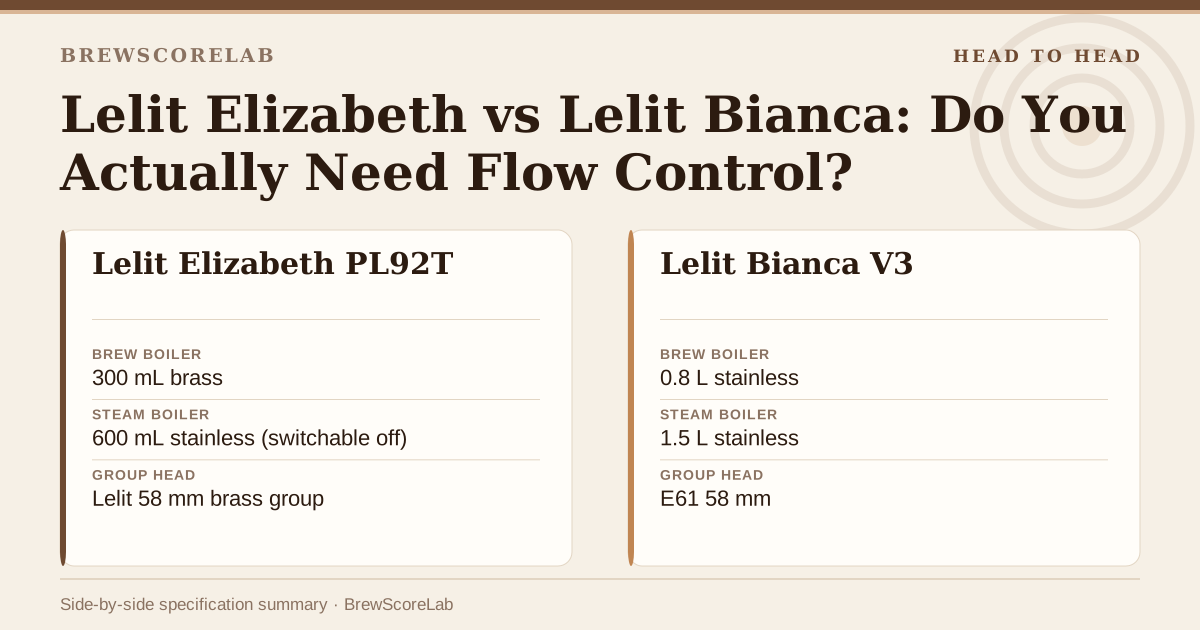
| Spec | Lelit Elizabeth PL92T | Lelit Bianca V3 |
|---|---|---|
| Brew boiler | 300 mL brass | 0.8 L stainless |
| Steam boiler | 600 mL stainless (switchable off) | 1.5 L stainless |
| Group head | Lelit 58 mm brass group | E61 58 mm |
| Flow control | None | Manual walnut paddle, standard |
| Pump | Vibration | Rotary |
| Water supply | 2.5 L tank | 2.5 L modular tank (three mounting positions) or plumb-in |
| Feedback | PID display, dual pressure gauges | PID plus dual manometers |
| Brew temp ceiling | Up to 95 °C / 203 °F | PID adjustable |
| Warm-up | Brew-ready in about 10 minutes from cold | Roughly 20 minutes, four power modes |
| Footprint (W×D×H) | 32.2 × 26 × 38.2 cm | 11.5 × 16 × 15.75 in |
| Weight | About 12 kg | About 58 lbs |
The Elizabeth’s figures are Lelit’s own: the PL92T listing specifies a 300 mL brass coffee boiler, a 600 mL stainless steam and hot water boiler, a 2.5 L tank, the LELIT58 commercial group and a 3-way solenoid valve. Lelit describes the Bianca more tersely — “coffee machine with L58E group and manual control of the water flow” — which is, in one sentence, the entire reason people pay the difference.
That warm-up row deserves a second look. The Elizabeth’s small brass brew boiler and lighter group get to brew temperature far faster than the Bianca’s E61 assembly, which is a real quality-of-life difference on a workday. The flip side is thermal mass: the Bianca’s heavier group is more forgiving across consecutive shots and long preinfusions.
When Flow Control Actually Changes the Cup
Flow control is not a gimmick, but it is not universally useful either. The paddle lets you start a shot at low flow so the puck saturates gently, then open up and taper off as extraction proceeds. Where that pays off:
- Light roasts. Denser, harder-to-extract coffees benefit most from an extended low-pressure preinfusion. This is the single strongest argument for the Bianca.
- Small or unusual doses. A tapering pressure curve gives you a way to rescue a shot that would otherwise gush.
- Single origins you plan to dial in properly. If you are changing bags every couple of weeks and want a lever on extraction beyond grind and dose, the paddle is that lever.
Where it does not pay off: a well-roasted medium blend, pulled at a normal ratio, going into six ounces of steamed milk. Under those conditions the Elizabeth’s fixed pump profile is entirely adequate, and the extra variable mostly gives you a new way to be inconsistent. If you have not yet nailed a repeatable routine, the honest next step is dialling in espresso properly on the machine you have, not buying a paddle.
When the Elizabeth Is the Smarter Buy
The Elizabeth’s case for itself is not “cheaper Bianca.” It is a genuinely different machine with real advantages:
It is small. At roughly 32 cm wide and 26 cm deep, it fits under most wall cabinets and leaves room for a grinder. The Bianca is a full prosumer footprint and looks it. If counter space is tight, our small kitchen machine guide makes the same argument at every price tier.
It is fast. Brew-ready in about ten minutes from cold means you can turn it on when you get up rather than putting it on a smart plug timer.
The steam boiler switches off. If you are only pulling straight espresso for a stretch, you can run the brew boiler alone and cut warm-up and power draw. The Bianca has power modes but the Elizabeth’s outright steam-off switch is simpler.
It is deeply programmable. Lelit’s controller exposes an unusual amount for the tier — the LCC electronic control system with its OLED display covers brewing time, preinfusion and stand-by settings — which is why the Elizabeth has such a devoted following. Our full Elizabeth review goes through the menu in detail.
When the Bianca Is Worth the Jump
Beyond the paddle, three things justify the Bianca for the right buyer.
The rotary pump is quieter and smoother than any vibration pump, and it is the difference between a machine you notice at 6 a.m. and one you do not. The plumb-in option turns the Bianca into a permanent installation — no tank refills, and the modular reservoir can be moved to whichever side suits your counter until you commit. And the 1.5 L steam boiler simply does not run out; if you host, or you make four flat whites in a row, the Elizabeth’s 600 mL boiler will need recovery time that the Bianca will not.
There is also a longevity argument. The E61 group is the most widely supported group design in home espresso, with gaskets, screens, and service parts available essentially forever. That matters if you intend this to be the last machine you buy — and it is part of why the Bianca keeps showing up in cross-brand comparisons like Lelit versus Breville and the Bianca against Breville’s Dual Boiler.
FAQ
Is the Lelit Bianca worth it over the Elizabeth?
It is worth it if you drink light roasts, host frequently, or want a plumbed-in machine with a rotary pump. It is not worth it if your routine is one or two milk drinks a morning from a medium blend — in that case the Elizabeth produces the same drink, heats faster, and leaves you counter space and grinder budget.
Can the Lelit Elizabeth brew and steam at the same time?
Yes. It is a genuine dual boiler with a 300 mL brass brew boiler and a 600 mL steam boiler, each with its own PID, so you can pull a shot while the steam wand is live. That is the core reason it competes above its tier — see how it fares against Breville in our Elizabeth vs Breville Dual Boiler comparison.
Does the Elizabeth have flow control or pressure profiling?
No. It has programmable preinfusion through its controller, but no manual paddle and no way to vary flow mid-shot. Aftermarket flow control kits exist for E61 groups, not for the Elizabeth’s group, so this is not something you can add later.
Which one is better for light roast coffee?
The Bianca. Long, gentle preinfusion at reduced flow is the standard tool for extracting dense light roasts, and the paddle plus the manometers make that repeatable. The Elizabeth can pull good light roast shots but you are working with grind and temperature only.
How long does each take to warm up?
The Elizabeth is brew-ready in roughly ten minutes from cold, though the group benefits from a few extra minutes and a flush. The Bianca is generally quoted around twenty minutes, which is typical for an E61 machine carrying that much brass.
Do I need a better grinder for the Bianca?
You need a good grinder for either, but the Bianca punishes a weak one more visibly — flow control exposes distribution problems rather than hiding them. Anything in our single dose grinder guide is the right class of tool for either machine.
Conclusion
The Elizabeth and the Bianca are not a good/better pair. The Elizabeth is the compact, fast, quietly over-specified dual boiler for people who want excellent milk drinks without ceremony. The Bianca is a profiling machine with an E61 group, a rotary pump, a large steam boiler, and a plumbing option, aimed at people who want to work on their espresso rather than just drink it.
Ask yourself one question: in the next year, will you actually move that paddle? If yes, buy the Bianca and read the Bianca V3 review first. If you hesitated, the Elizabeth is the machine you will be happier with — and the money left over buys a grinder that will improve your coffee more than flow control would have.