Lelit vs Breville Espresso Machines: Which Brand Fits You?
Lelit vs Breville: Which Espresso Machine Brand Should You Choose?
Here’s a comparison with a plot twist: since 2022, Lelit and Breville have belonged to the same parent company. Breville Group acquired the Italian manufacturer, yet the two brands continue to build machines with almost opposite philosophies. Understanding that philosophical split—not any single model matchup—is what actually answers the “Lelit or Breville?” question.
Quick Answer
Choose Breville if you want convenience: near-instant heat-up, built-in grinders, guided interfaces, and strong all-in-one value from budget tier to premium tier. Choose Lelit if you want a traditional Italian prosumer machine: commercial-grade boilers, the 58mm portafilter standard, manual technique, and a machine built to be repaired rather than replaced. Both brands make excellent espresso—Breville optimizes your first year, Lelit optimizes your next decade.
Brand Philosophy at a Glance
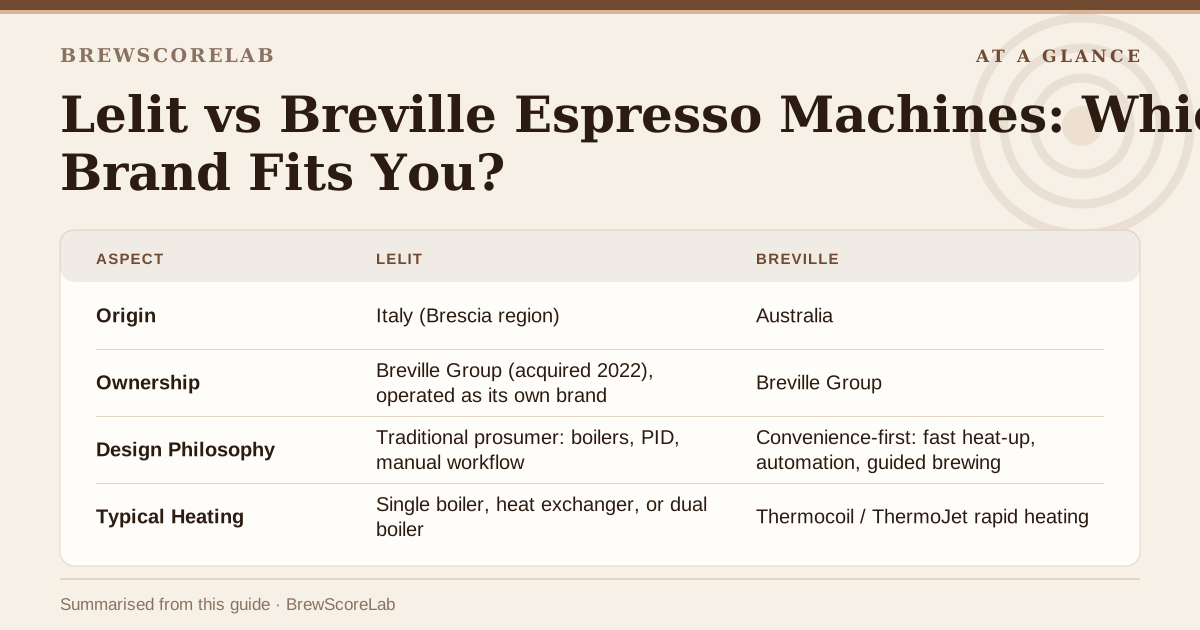
| Aspect | Lelit | Breville |
|---|---|---|
| Origin | Italy (Brescia region) | Australia |
| Ownership | Breville Group (acquired 2022), operated as its own brand | Breville Group |
| Design Philosophy | Traditional prosumer: boilers, PID, manual workflow | Convenience-first: fast heat-up, automation, guided brewing |
| Typical Heating | Single boiler, heat exchanger, or dual boiler | Thermocoil / ThermoJet rapid heating |
| Warm-Up Time | Proper boiler warm-up required | Seconds on ThermoJet models |
| Portafilter Standard | 58mm commercial standard on its prosumer machines | 54mm on most models; 58mm on flagships |
| Built-In Grinders | No (separate grinder expected) | Yes, on much of the lineup |
| Automation | Minimal—technique is the point | Extensive: dosing assistance, auto milk texturing on some models |
| Serviceability | Standard parts, repair-friendly design | More integrated assemblies |
| Range | Mid tier to premium tier | Budget tier to premium tier |
| Best-Known Models | Elizabeth, MaraX, Bianca | Bambino, Barista Express, Barista Pro, Dual Boiler, Oracle |
How Breville Thinks
Breville designs backward from the busy morning, right up to the Oracle line. Its ThermoJet machines—like the Bambino Plus—reach brew temperature in seconds, which quietly removes the biggest reason people abandon home espresso. The Barista series bundles conical burr grinders into the chassis so one appliance covers the whole workflow; our Barista Express vs Barista Pro comparison shows how that family ladders up. At the top, the Oracle machines automate grinding, tamping, and milk texturing almost entirely.
The through-line is guidance. Displays, timers, pre-set pressure profiles, automatic pre-infusion—Breville machines are engineered so that an inexperienced owner gets a drinkable result in week one. The trade-offs are real but honest: 54mm portafilters on most models mean a smaller accessory aftermarket, sequential brew-then-steam on the single-heater machines, and integrated assemblies that favor replacement over repair as the years stack up.
How Lelit Thinks
Lelit builds scaled-down commercial equipment. Stainless steel boilers, adjustable PIDs, commercial-style steam wands, and the 58mm standard across its prosumer machines—everything assumes you’ll supply the skill and a proper grinder. The Elizabeth packs a genuine dual boiler into a compact chassis; the MaraX applies heat-exchanger engineering to the classic E61 group; and the flagship Bianca adds a flow-control paddle that lets you shape the pressure profile by hand—we go deep on it in our Lelit Bianca V3 review.
Nothing in a Lelit hurries you. There’s no built-in grinder, no automatic milk mode, and a warm-up period that assumes espresso is a ritual rather than an errand. In exchange you get temperature stability that rewards technique, standard parts that keep decades-old machines serviceable, and headroom you will not exhaust as your skills grow.
Where Each Brand Wins
Breville wins on:
- Speed — seconds to brew temperature on ThermoJet models versus a real warm-up on any boiler machine
- Completeness — grinder, machine, and guidance in one box at one price
- Approachability — the shortest distance from unboxing to a good latte
- Range — options from a budget-tier first machine to premium-tier automation
Lelit wins on:
- Milk-drink workflow — dual boiler and heat-exchanger models brew and steam simultaneously
- The 58mm ecosystem — every commercial-standard basket, tamper, and bottomless portafilter fits
- Longevity — repair-friendly construction with standard, available parts
- Ceiling — flow control and adjustable temperature give advancing skill somewhere to go
Head-to-Head Matchups Worth Reading
Brand philosophy becomes concrete when specific machines square off. At the accessible end, Lelit Elizabeth vs Breville Barista Pro captures the entire debate in two machines: dual boilers versus built-in grinder. One tier up, Lelit Elizabeth vs Breville Dual Boiler pits Italian restraint against Breville’s automated flagship. And at the summit, Breville Dual Boiler vs Lelit Bianca is the clearest picture of where the two roads ultimately lead.
Who Should Buy Which Brand?
Choose Breville if you:
- Are buying your first espresso machine and want everything included
- Prioritize fast, low-friction mornings over ritual
- Prefer guided interfaces and automation to manual technique
- Want strong value at the budget and mid tiers
Choose Lelit if you:
- Make milk drinks daily and want simultaneous brew and steam
- Already own (or will buy) a serious standalone grinder
- Value repairability, standard parts, and long service life
- See espresso as a craft you intend to get better at
Still unsure which philosophy fits your kitchen? Our espresso machine buying guide walks through the decision from scratch, without brand loyalty.
FAQ
1. Is Lelit owned by Breville? Yes. Breville Group acquired Lelit in 2022. Lelit continues to operate as its own brand with manufacturing in Italy, and the two product lines have remained distinct in design philosophy.
2. Does shared ownership mean the machines are the same inside? No. Lelit machines remain traditional Italian boiler designs with 58mm portafilters and manual workflows; Breville machines keep their rapid-heating, automation-focused engineering. The acquisition changed the ownership structure, not the products.
3. Which brand is better for beginners? Breville, in most cases. Built-in grinders, instant heat-up, and guided interfaces flatten the learning curve. A committed beginner can absolutely start on a Lelit—it just asks for a separate grinder and more patience up front.
4. Which brand is better for lattes and cappuccinos? For daily multiple milk drinks, Lelit’s dual boiler and heat-exchanger machines have the stronger workflow, steaming while the shot pulls. Breville (spec sheets here) counters with automatic milk texturing on models like the Bambino Plus and Oracle—less capable in parallel, more capable hands-free.
5. Do Lelit machines cost more than Breville machines? The ranges overlap, but Breville covers the budget tier while Lelit starts around the mid tier and climbs. Factor in a standalone grinder for any Lelit; Breville’s all-in-one models fold that cost into the box.
Conclusion
Lelit versus Breville isn’t really a quality contest—it’s a values contest run under one corporate roof. Breville engineers the friction out of espresso: instant heat, integrated grinders, automation that makes week one delicious. Lelit engineers the ceiling in: commercial standards, stable boilers, and machines that improve as you do. Buy Breville to make espresso easy. Buy Lelit to make espresso yours.